Tag Archives: novel

Logic Gaps…

So I have gone through the first seven chapters of Slipwater – tidied it up, trimmed the fat, tried to squeeze as much story out of my words as I can – and although writing a novel is somewhat like painting the Sydney Harbour Bridge (in that once you reach the end you head back to the other end and start again) it’s getting to the point where I’m really happy with the story on a sentence by sentence level.

editing-imageThe problem (if there is a problem) is… distance.

Slipwater is the town central to the plot of the novel, but I have played a little fast and loose with its distance from other locations in the story. Ideally it needs to be further away, but then that interferes with how long it takes to get there, which also means my day/night cycle is turned on its head, which in turn doesn’t really work for the characters involved in the travelling…

You get my drift.

I appreciate all of this is without context and therefore completely meaningless, but the more of the onion that I peel away the more apparent it becomes that I will need to fix this before I can send the novel out for publication.

I could probably get away with it – most readers would likely not even notice – but I’ve been sitting with it for a long time now and these logic issues scream at me from the virtual page. If I’m going to give myself the best shot at success… I need to ensure that what I send out is the best it can be.

This is What Happens in 2018…

I’m not one for making resolutions – be they New Year ones or otherwise. The first day of the year is a fairly arbitrary time to be changing certain patterns in your life, or to be telling yourself and others that things are going to change or this year things will be different… but today I’m willing to follow social convention and do just that.

New-Years-Resolutions

The one thing I want to do in 2018 is to find a publisher for Slipwater. I don’t think this is out of my reach at all, and if I thought this was just a pipe dream I wouldn’t be writing about it here. The story is interesting, thought-provoking, and well-written. It’s not Dickens or Shakespeare by any means, but it is miles better than a lot of novels I’ve read in recent years! I am well on the way to completing a final draft of the manuscript, and am very happy with what I’ve produced so far, and I’ve pencilled in February as the month to start the process of sending it off for scrutiny.

So that’s it: find an editor who likes it. That’s not so much to ask for, is it? And if by this time next year I’m still twiddling my thumbs…

…well, that’s not going to happen.

Watch this space.

Draft: Completed…

the-end

I really thought I was going to finish this draft of my novel in November, but as I write this the clock has just ticked over into Christmas Eve. It seems that (not for the first time) I underestimated the difficulty of the task at hand and overestimated the time I had available in which to do it.

That being said, it’s now done. As of approximately two minutes ago, it’s finished. This draft is finished, I mean. It’s cohesive from start to finish for the first time in forever and I’m extremely happy that I got this out of the way in 2017. Am I happy with it? Will it improve when I go back and tie up all the loose ends and paper over the cracks? Yes to both of the above. Watch this space.

It comes in at just under 83,000 words… a pretty decent length for what I am going for, but I think that number may grow a little in the coming weeks. I would ideally love to have the tidying up process completed by the beginning of February, and I think with a little dedication I can get that done.

I have to get up for work in less than five hours, but at this precise moment I don’t really care that I’ll be tired tomorrow, or that my day will end up dragging long as a result, because I’ve taken a step towards where I want to be and – more importantly – where I want this story to be. I can ride this high all the way until the end of the year and beyond.

2017 is certainly shaping up to end much better than it began.

The Novel…

…is nearly done.

I’m experiencing a little literary law of diminishing returns: the more I put into the novel, the harder it is to squeeze out a result. But it’s fine, I’m enjoying the difficulties, and that’s half the battle. I have arrived at this late stage of the game before and walked away, but the fact that I have no intention of doing that this time is a very good sign.

howtowriteanovel

I have over 78,000 words in the bag, and am currently putting the finishing touches to Chapter 27, which – after some organisational changes in the way I want the story to play out – is now the penultimate chapter of Slipwater. I’m not cutting any of the content, I just think it works better as two chapters instead of the original idea of four.

I’m happy that I know what happens in Chapter 28, so all I have to do now is write it. I’m also fairly certain of the length of that final chapter, so my total word count for this draft should be approximately 84,000 words, give or take. At this rate it will definitely be done in the next ten days, or the next five if my speed dealer’s new stash has arrived.

So that finish line is in sight, or at least… the marker for the end of the first lap. And now that I’m so close, I guess the best question to ask myself is – why the hell has it taken me this long to get around to finishing it?

How Long is Too Short…?

The last week or so has been a little slower with regards to the writing of Slipwater, but I’m still moving forward towards that finish line, and that’s the important thing. I now have twenty-six chapters and 75,000 words in the bag, leaving me with probably four chapters and about 12,000 words to complete. At this rate I’ll give myself until late November to have this pass completed – or around Thanksgiving for you guys in the US – but that’s a pretty generous timescale.

maxresdefault

One of my concerns about Slipwater has always been its length. At my current projection it will not break 90,000 words, and my thinking was that this would be on the shorter side of things. Of course, that is not the end of my journey. Word count is a fluid thing at this stage, and there is potential for it to move drastically once I go back to the start and beginning locking it all down, although I really don’t foresee that happening.

The acceptable length for a novel is vague and varies with genre and each publisher’s individual tastes. It also depends on who you are. Famous authors will be given a lot more freedom, and will be able to cut below and above these numbers, as they are at least in part, trading on their name and reputation. For guys like me, things are a little more strict.

Traditionally, 40,000 words is considered to be the lower limit for a novel, but it’s hard to see anything as short as that finding publication these days, especially as a debut offering. At the other end of the spectrum, anything approaching 150,000 words will likely see you struggle to find a publisher. And if you happen to write something up around the quarter-million words mark, well… I wish you the very best of luck.

There’s a chance yours may be too long or too short, but in between those outliers is a whole world of space in which most of us reside, and it’s extremely likely that you fall somewhere in the middle of that spectrum, so you shouldn’t spend too much time worrying about length. As for me, it would appear that Slipwater is right there in the mix, where it needs to be at the moment.

So, does size matter? Sure. But nowhere near as much as you’ve been told.

Keep On Keepin’ On…

I’ve passed 70,000 words of my current pass at Slipwater, and I’m now at the point where most of what remains is going to have to be completely rewritten. Actually, I should be honest: it’s all going to have to be rewritten. Why? Because…

The-first-draft

Although I have messed around with the first two thirds of the story many times over the years – and I’m very happy with where it is now – the final stretch was only ever done once. In 1997. Well, I didn’t know anything in 1997. Hell, I was still a virgin in 1997. But more appropriately, some of the stuff I wrote was terrible in 1997. Okay, yes, some of the stuff I write in 2017 isn’t much better, but baby steps.

However, there are a couple of encouraging lights in the darkness. Firstly, I have an outline and a very good idea of where the story heads from this point onwards. And secondly, the novel is probably going to top out at just shy of 90,000 words, so there isn’t too much further to go.

Oh, and thirdly, this time I’m not stopping until:

flat,550x550,075,f

Tickling a Writer’s G Spot…

creative-orgasm

There is no greater high as a writer than getting that sentence or paragraph… just right. You know what I mean – it’s that collection of words that you have spent far longer than you would care to admit, dissecting, rearranging, clipping, deleting and then reinstating, only to find that when all is said and done it doesn’t look all that different on your laptop from when you started messing around with it in the first place. But somehow, now, it just works.

Or maybe you don’t know what I mean. and that’s all right. I will accept – it’s a strange place to procure joy. I had one such literary climax yesterday, at the beginning of Chapter 23 of my novel in progress.

Carl had indeed given the blueberry waitress one of his Andrew Jackson twenties, and her initial scepticism as to its authenticity was alleviated when he quickly complimented her on the way she wore her hair in order to distract her. He coupled this with the kind of smile he had usually reserved for Beth – or before her – girls he had been interested in. The waitress had already taken another twenty from the till in order to satiate her uncertainty about the origin of Carl’s note, but instead of drawing comparisons as she had intended, she simply blushed, and thanked him for his kind words. When he told her she could keep the change she thanked him for that too and dropped both notes into the tray without any further ado.

This seemingly insignificant 130 word snippet appears in the narrative after 63,000 other words have gone before it. Most of those other words are (hopefully) very good, but it was as I was fiddling around with this particular chunk of text that I really felt things click into place. Why? I’m not entirely sure. But it’s a great feeling to have.

Completely out of context, this paragraph means absolutely nothing to anybody but me, and that’s fine, because the point is something intangible – something I could spend 63,000 more words trying to qualify and still not get anywhere near the head of the nail.

All right, fine, I will admit that likening it to a sexual experience is a little hyperbole on my part, because finding that perfect paragraph is just not comparable to sex in any way whatsoever: it’s much better than that.

Or maybe I’m just not doing it right.

Friday Fiction Fixes #21…

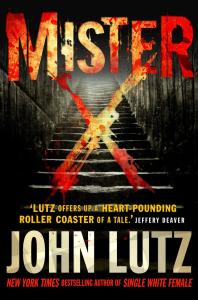
Mister X by John Lutz – 2010

imagesI could probably be rightfully accused of having a predilection for those authors whose books I am already familiar with, so it’s infrequent that I read a novel by someone that not only have I never read before, but someone that I have not even heard of before. Mister X is one of those novels, by one of those authors. As it turns out, Lutz is a pretty popular writer as well – who knew?
Mister X is a crime thriller about the hunt for a serial killer who enjoys carving up his victims in all manner of wonderful ways. His trail has gone cold and interest in his capture only begins again when a strange woman with a curious connection to one of the victims shows up out of the blue in the office of the case’s lead detective.

It’s a fairly standard entry into an extremely crowded genre, and while it does nothing in a particularly outstanding manner, everything it does do, it does… competently. The characterisation is satisfactory; and the plot is (for the most part) fairly interesting. Yeah, Mister X is a competent novel in every respect – just don’t expect it to make a lasting impression on you.

Everything Started, Ends…

Twenty years ago I completed a draft of Slipwater – the only novel I have ever written. Let that sink in for a moment. Twenty. Years. Ago. My novel is legally old enough to buy a drink!

swore-i-would-write-my-novel-katie-murphy-author

In 1997 Slipwater was an extremely complicated idea in my head, which is at least part of the reason that the first draft – which clocks in at 88,000 words – probably runs out of steam towards the end. Or at least, I did. I just wanted to get it finished. At twenty-one years old I didn’t have the necessary life experience to tackle a lot of the themes I was getting into, so it was rushed.

In the decades since then I have told myself I am going to get back to it one day, and I’ve meant it every time. Over the years I have gone back to it… off and on. I even got so far as to redraft about 70% of the novel, but for some reason or other, I have always let it slip.

Between the years of 2005 and 2011 I sent it off to several publishers. Some wanted the first few chapters; others the first ten pages. One of these places did actually then request to see the whole manuscript, which put me in a bit of a pickle because it was at a time when I didn’t have a complete draft from start to finish. C’est la vie.

Anyway, the point is – I’m getting back on the horse again.

What’s Slipwater about? Oh, a lot of things. It’s a police thriller about the bond of marriage, and of friendship, and how a personal tragedy affects both of those things. It’s about a serial killer and second chances.It’s about the drive-through town of Slipwater and the strange secret it possesses.

But mostly… it’s about damn time I finished it.

Friday Fiction Fixes #12…

Velocity by Dean Koontz – 2005

Koontz-Dean-Velocity-4003-pI’ve read dozens of Koontz novels over the years – from the pretty terrible to the pretty terrific – but the man has earned my respect and gets a pass for the odd misfire. He is one of those authors I will always find a way back to if I can’t think of anything else to read. I’ve always envied his style. Koontz doesn’t write long-winded paragraphs but squeezes a lot of character into so few words. It’s a lot harder than it looks. It’s definitely a skill I admire, and there are very few people who can do it better.

For the first third of Velocity, I really thought it was going to be up there with his best. The idea is great: Billy Wile, finds a hand-written note under his windshield wiper (see the set-up spoiling cover picture above) and that’s it. Then we’re off to the races. It runs at a blistering pace, with a few clever moral quandaries to mull over along the way. The first two-thirds of the novel is fantastic, but once Billy starts to gain a little perspective on the situation, the story slows down, and it really isn’t as exciting or interesting anymore. Unfortunately it pulls towards a fairly unsatisfying conclusion with a couple of plot holes that you could drive a truck through.

Koontz knows how to pace a very good chase thriller, so even if the story wanes you never feel as though you’re sinking into quicksand because you’re always out the other side before you know it. Does he sometimes phone it in? Sure, that’s a valid criticism: his work can be a little formulaic at times, but there’s nothing inherently wrong with that. People like what’s familiar. If you enjoy beer, you don’t stop drinking it because it tastes the same as last time, do you?