Monday Movie Mentions #20…

The Public Enemy (1931)
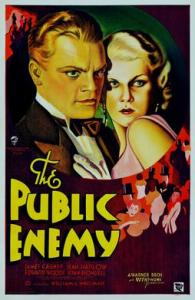
The_Public_Enemy_1931_PosterThe Public Enemy is almost ninety years old, so everyone that you see on screen has now passed on. It’s an unimportant observation, but something that always gives me pause when I’m watching a movie from this era.

It was produced in that five year window during the early thirties when ‘talkies’ were a new thing, so motion picture regulations were not being enforced as they would be thereafter. Consequently there are some suggestive scenes and dark moments here that may have been lost to the cutting room floor had the piece been made at another time.

James Cagney was always a fantastic gangster on screen; in my opinion, the best there ever was. He was a much better actor than most, and the problem that saddles him with is that he gives the best performance in The Public Enemy by quite some margin. Everyone else looks like a drama student by comparison. Some of that is down to how uncomfortable actors may have been with the new technology, but Cagney takes to it like the proverbial duck.

The Public Enemy was Cagney’s first foray into the genre that would make him famous. It’s difficult to take seriously for a first time viewing in 2017, because the world has moved on so much since, but if you can set aside your modern bias you’ll find that this simplistic tale of trying to X your spot in a tough world that is pushing back against you, is a stellar movie… with a powerful and memorable final scene.

Sunday Song Suggestions #20…

King of Hollywood – the Eagles – 1979

Well it took me twenty weeks to get here, but I finally got around to speaking about my favourite band, the Eagles.

King of Hollywood is one of the best songs that they ever recorded, and because it was never released as a single, it’s not particularly well known to those who are not fans of their work. It’s a track from their sixth album, The Long Run, their final studio offering before they took the rock world’s longest vacation.

The late Glenn Frey takes lead vocal duties for the first three quarters of the song, before Don Henley comes in to bring it home. From the way the song fades in, to the effortless guitar throughout, to the fade out nearly six and a half minutes later, King of Hollywood is a classic of seventies rock storytelling, cynically biting at the behaviour of certain producers in Tinsel Town, and how those who want to be stars can be dazzled by the bright lights.

Mainstream music is very safe these days, and the industry doesn’t produce tracks like this anymore – not as a rule, and certainly not by acts as influential as the Eagles. It’s a shame, because this is just the kind of thing that would get you noticed.

Friday Fiction Fixes #19…

Fifty Shades of Grey by EL James – 2011

220px-50ShadesofGreyCoverArtThis is one of only three novels that I’ve started and failed to finish. The other two are classics that I intend to go back to one day. Fifty Shades of Grey is no classic. It’s easy to believe that this started life as a piece of fan fiction for the Twilight saga, because this is poorly written even for a first draft, let alone something that has (allegedly) gone through several.

I’ve only read the first seventy pages of this novel, so this isn’t a review, nor is it my opinion of the book as a whole. It is however, a place for me to say how awful I believe those first seventy pages are, and how head-scratchingly annoying it is that the author made many millions of dollars off the back of something that quite blatantly pandered to the lowest common denominator.

I feel the colour in my cheeks rising again. I must be the colour of The Communist Manifesto.

Fifty Shades of Grey was sold as the most sexually charged and hedonistic mainstream work since Caligula, and if that is true and not just crass marketing hyperbole, then the genre of erotic fiction is in a lot of trouble. Now, have I fed into this whole thing by even starting the novel in the first place? Yeah, probably. But I had to find out what all the fuss was about.

His lips part, like he’s taking a sharp intake of breath, and he blinks. For a fraction of a second, he looks lost somehow, and the Earth shifts slightly on its axis, the tectonic plates sliding into a new position.

I had an open mind going in, but that soon became very difficult. The lead character, Anastasia (yes, that’s her name) is fascinated by the older and more experienced Mr Grey, although she hardly knows him at all and lacks the confidence to say much of anything to him.

And from a very tiny, underused part of my brain—probably located at the base of my medulla oblongata near where my subconscious dwells—comes the thought: He’s here to see you.

Going in I thought this was going to present a strong female lead, but instead, Anastasia comes across as nauseatingly weak. She is the single most pathetic, insipid, can’t-make-her-damn-mind-up protagonist that I have read in any novel. And for a novel that’s sold as being all about sex, there sure as shit isn’t so much as an exposed thigh in those first seventy pages. I know Anastasia is all about her flower, but goddamn woman!

Perhaps the four hundred pages that follow is filled with the most mind-blowing coitus ever commited to paper, but I doubt it.

Shame is the Price of Passion…

Dementia is more than just a room full of elderly men and women sitting in orphaned armchairs around a television that’s been cranked up so loud that you feel the volume coming through the soles of your shoes.

It’s more than the old man with medals pinned to his chest, who speaks to me as if we are lifelong friends – even though I have never seen him before. He asks me if I know why his wife hasn’t been to visit him for years, and with the very next breath he tells me that she died during the war.

It’s more than the old woman who taps my shoulder every day and continually asks me for a pen so that she can write down the seven digit number that she just keeps repeating over and over and over, until now, it’s something that I’m sure will bounce around inside my head until something else pushes it out.

candidate-1563787-2014-09-23-15-27-51

One of the first three paragraphs is entirely fiction. I made it up. Call me an unreliable narrator… because dementia is more than all of those things. Dementia is also material, for whatever I happen to be writing at the time, or perhaps something I haven’t even started yet. And while that sounds extremely brutal and self-serving, to use a phrase that I absolutely loathe: it is what it is.

Being around the disease daily – I’m ashamed to admit – stimulates the creative juices within me. I love the random and unique conversations I overhear or become a part of while visiting my grandma; nuance and detail that I otherwise may have missed. Nursing homes are (ironically) extremely deep wells of experience, and rich with the history of the individuals who live there.

Now, I’m not advocating a field trip to your local old folk’s home if you don’t have a relative or friend there who you care about, but those little moments have become a crucial side effect of the excursion.

So whenever I doubt myself or try to dismiss the blood, sweat, and tears that I’ve put in to my words over the years, it’s guilty moments like these that remind me: yes, motherfucker, you are a writer.

And if I’m doing all that while I’m there, I guess I really must be.

Tuesday TV Testimonials #19…

Happy Days (1974 – 1984)

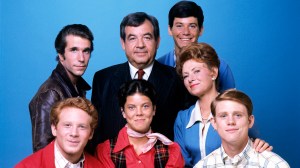
HAPPY DAYSHappy Days was one of the most successful sitcoms of the seventies. Setting aside the catchy theme tune, a lot of that was down to the breakout success of The Fonz – probably the single most well known character in the history of comedy on the small screen.

The show was never intended to be about The Fonz – it was meant to be about the Cunningham’s, which ostensibly it continued to be – but the character was so popular and Henry Winkler did such a great job with the role, that the producers had no choice but to elevate him into the headline spot.

3565349451Set during the fifties and sixties, Happy Days was so ingrained in that familiar culture and played off the public nostalgia for that particular time period so well, that a lot of younger people today think it was produced in those rock ‘n’ roll years it was representing, instead of being two decades removed.
Did Happy Days stay on television too long? Probably. After all, the phrase jumping the shark was born in an episode when The Fonz literally did just that – but it’s a well-remembered, family friendly sitcom, that was really the benchmark for such things at the time. Over thirty years after its final episode aired, Happy Days still manages to feel fresh, and still raises a smile.

Monday Movie Mentions #19…

Some Kind of Wonderful (1987)

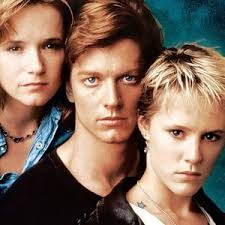
imagesIt’s only after I watched Some Kind of Wonderful for the umpteenth time recently that I realised how much it had in common with Pretty in Pink, the John Hughes penned movie that had been completed the year earlier.
They have the same director, same writer – even the same basic plot structure. In fact, these two movies are so similar in concept and execution that they could have been separated at birth, only with Some Kind of Wonderful being the child that has been (unfairly) abandoned at the side of the road never to be spoken about. It’s an unpopular opinion, I know, but this is the more enjoyable film.

Watts: Don’t mistake Paradise for a pair of long legs.

Eric Stoltz is Keith, the working class boy who falls for Amanda, the most popular girl in school, played by Lea Thompson. She is, of course, gorgeous and going out with a rich tool. Mary Stuart Masterson is Keith’s best friend Watts who… well, if you’ve seen any eighties high-school based romantic comedies you’ll know where this goes, but it’s a lot of effortless fun along the way. The three leads play well off each other, with Stoltz being the weakest link – there’s just something about him as an actor that I’ve never bought into.

Some Kind of Wonderful is considered a part of the loosely defined Brat Pack canon, and while it is certainly not the best of that bunch, it’s in the top third… and like I said earlier, it’s better than that other one.

Sunday Song Suggestions #19…

The Yoke (GUOTR) Alexander O’Neal – 1991

This was a Jam & Lewis number, because in the early nineties it seemed that most of the chart music you heard had been written by those guys. And in a clever segue, this song was my jam… back when I was still young enough to get away with using phrases like that, of course.

O’Neal was a fairly well known R&B performer in the eighties, but I don’t think he was ever really given his dues. He was always overshadowed by other singers who played in that wheelhouse, especially another favourite of the ladies, Luther Vandross. The public is narrow-minded like that. Two black guys who produce songs under the same umbrella, and suddenly there’s only room for one cowboy in town.

The Yoke is one of O’Neal’s lesser known tracks. It was released as a single but shamefully got nowhere: taste is not ubiquitous. New jack is not a sound that usually does it for me, but this is an exception. I am even down with the rap verse in The Yoke, a musical idiom I am traditionally opposed to.

This is a song that’s best played without any inhibitions, and my tinny laptop speakers don’t do it any justice, so whack up the bass, turn it up loud, and don’t worry if people stare at you – they’re just jealous.

Friday Fiction Fixes #18…

The Raven by Edgar Allan Poe – 1845

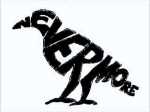
hqdefaultThe Raven is the most well known poem penned by Poe, and quite probably the most famous poem in all of horror. It’s quite a lengthy piece – certainly much longer than the five line limericks I was quite partial to writing when I was at school – but it has a good, consistent rhythm and quite the creepy atmosphere.

Now, hands up: I’m not much of a poetry professor. I know some of it rhymes and some of it doesn’t. But if you’re the kind of person who gets excited about iambic pentameter and the differences between a haiku and a tanka, you’ll likely have a better time talking to someone else.

Poe was one of the founding fathers of the horror genre – a guy you would be hard pressed not to put on your Mount Rushmore of that particular field – but as synonymous as his name is with the genre, Poe only completed one novel in his life. It’s very impressive to have made such a lasting impression based on short stories and poetry exclusively, and The Raven is a piece that will be talked about for years to come.

And Many More…

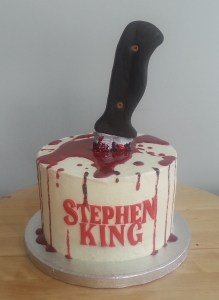
kingStephen King turned seventy years old today.a3c5ede143cc4dda46bc7d2e615e2fff--stephen-king-books-stephen-kings

Wow.

Yeah, we all grow up; we all get older. One day we all die. We shouldn’t ever be taken by surprise by these things, yet somehow there’s always one that catches us off guard. I still think of him as the guy on the left… although he’s now closer to this guy on the right.

Stephen King has been a part of my life for over twenty-five years – his words, his ideas. He has influenced me as a writer much more than I would care to admit. Hell, for a while all I was doing was a bad impression of him – at least, that’s how I saw it.

I feel like I know him just a little bit, even though I don’t actually know him at all. Never met him; never will. And that right there is the genius of a great writer. King’s ability to make an ordinary situation, extraordinary, and his knack for building characters that feel so real, you would not be surprised to turn the corner and bump into them, is something I have admired from afar for many years. That’s the power of imagination. Being able to harness that and making it a reality – even a fictional one – is worthy of applause.

My relationship with King has had its ups and downs over the years, for sure. He has written some stuff that has not done much for me – I’m not the kind of narrow-minded fan who can’t admit that. The Talisman. Dreamcatcher. And as much as it pains me to say, even most of The Dark Tower series. None of those set my world on fire. But when he gets it right, which he does more often than not, his words have the ability to soar. The Eyes of the Dragon. Misery. Needful Things. And many others. Classics.

Go read them.

Happy birthday, sir.

5b6424fe79d3248eb2bf6171b47d0b57

Tuesday TV Testimonials #18…

Alien Nation (1989 – 1990)

16ce8145892626b59a82e65548b1f588--movie-sequels-tv-movieFinancial difficulties for the network it was on ensured that Alien Nation – one of my favourite shows growing up – got the axe after only a single season of 22 episodes. Several years later five TV movies were produced, which continued the story, but it was never the same.

Alien Nation was set several years after an extra-terrestrial ship had crash-landed in the desert and these aliens had been integrated into society. It was another in the long line of California-based cop shows that proliferated TV at the time, but its unique selling point was its overarching sci-fi theme, and the fact that it offered a human and alien partnership in place of the usual mismatched cop premise.

Alien_Nation_TV_series_title_card

The Newcomers – as the alien race is called – have many quirks, which is the genesis of much of the show’s humour. They are bald with spotted or striped skulls; they have two hearts; they get drunk on sour milk; and the male of the species gives birth… after roughly four months.

Almost every episode of Alien Nation is a somewhat blatant social commentary on (usually) racism and (sometimes) sexism. It’s rarely subtle and never particularly clever, but these are such emotive subjects that sometimes obvious works just as well.